
Bile Duct Injury
- Home
- /
- Bile Duct Diseases
- /
- Bile Duct Injury
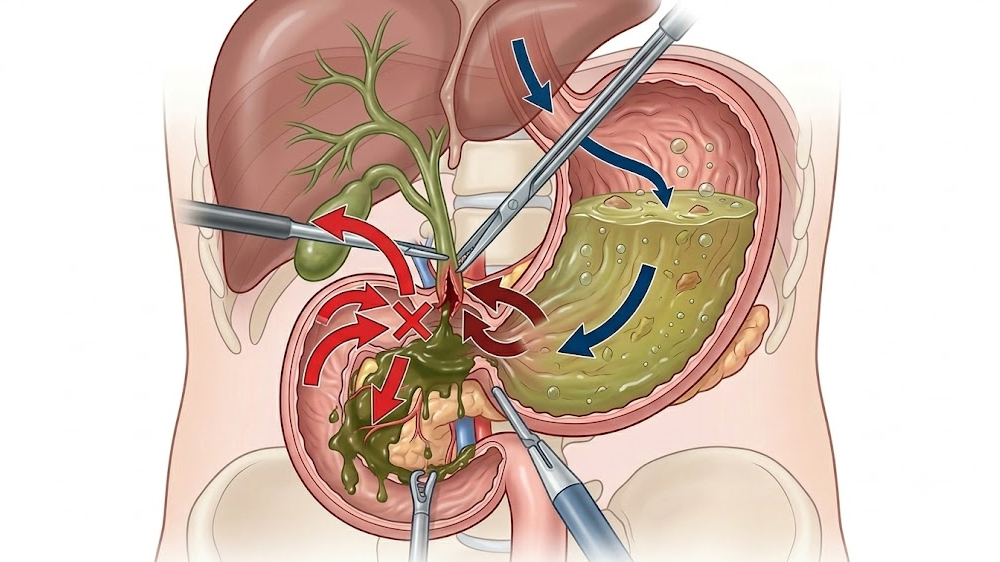
Expert Surgical Management of Bile Duct Injuries
Bile duct injury is a serious and potentially life-threatening complication that most commonly occurs during cholecystectomy (gallbladder removal) or other hepatobiliary surgeries. It can also result from trauma, penetrating injuries, or endoscopic procedures. Bile duct injuries can lead to bile leakage, stricture formation, cholangitis, and liver damage if not promptly and appropriately managed.
Dr. Surendra Pal Jakhar specializes in the diagnosis and surgical repair of bile duct injuries, offering advanced reconstructive procedures to restore normal biliary flow and prevent long-term complications. With expertise in both open and minimally invasive techniques, we provide comprehensive care for patients with complex bile duct injuries.
Types of Bile Duct Injuries
- Strasberg Classification:
- Type A: Cystic duct leak or small bile duct leak from the gallbladder bed
- Type B: Occlusion of a segmental bile duct (often right posterior sectoral duct)
- Type C: Transection without ligation of a segmental bile duct
- Type D: Lateral injury to the common bile duct without tissue loss
- Type E: Injury to the common bile duct with tissue loss (E1-E5 based on level)
- Bile Leak: Escape of bile from the biliary tree into the abdominal cavity
- Bile Duct Stricture: Narrowing of the bile duct due to scarring after injury or repair
- Complete Transection: Complete division of the bile duct
Common Causes
- Laparoscopic Cholecystectomy: Most common cause (0.3-0.5% incidence)
- Open Cholecystectomy: Less common but still a significant cause
- Liver Resection or Transplantation: Complex hepatobiliary procedures
- Abdominal Trauma: Blunt or penetrating injuries to the abdomen
- Endoscopic Retrograde Cholangiopancreatography (ERCP): Rare but possible complication
- CBD Exploration: During common bile duct exploration
Clinical Presentation and Symptoms
- Abdominal pain (right upper quadrant or generalized)
- Jaundice (yellowing of skin and eyes)
- Fever and chills (cholangitis)
- Nausea and vomiting
- Abdominal distension and tenderness
- Bilious drainage from surgical drains or wounds
- Elevated liver function tests (bilirubin, alkaline phosphatase)
- Delayed presentation with recurrent cholangitis or liver abscess
Diagnostic Evaluation
- Ultrasound: Initial imaging to detect bile collection, duct dilation, or stones
- MRCP (Magnetic Resonance Cholangiopancreatography): Non-invasive imaging to delineate biliary anatomy and identify injury
- ERCP: Diagnostic and therapeutic – can identify site of injury and place stents
- PTC (Percutaneous Transhepatic Cholangiography): For proximal injuries or failed ERCP
- CT Scan: To assess for associated injuries, fluid collections, or abscesses
- HIDA Scan: To detect bile leaks
Surgical Treatment Options
- Roux-en-Y Hepaticojejunostomy: The gold standard for major bile duct injuries with tissue loss – involves constructing a Roux limb of jejunum and anastomosing it to the proximal bile duct above the injury.
- Choledocho-Duodenostomy: Anastomosis of the common bile duct to the duodenum – suitable for select distal injuries.
- Bile Duct Repair with Stenting: Primary repair over a T-tube for clean, fresh injuries with minimal tissue loss.
- Laparoscopic Repair: In select cases, laparoscopic approach may be used for repair or drainage.
- Drainage of Bile Collections: Percutaneous or surgical drainage of bilomas or abscesses.
- Liver Resection: In cases of associated liver injury or segmental duct injury with liver atrophy.
Post-Operative Care and Long-Term Follow-Up
- Meticulous anastomotic care and monitoring for bile leaks
- Liver function tests and clinical surveillance
- Imaging follow-up (US, MRCP) at regular intervals
- Management of recurrent strictures with endoscopic or percutaneous interventions
- Long-term follow-up is essential as strictures can develop years after repair
Why Choose Dr. Surendra Pal Jakhar?
Dr. Surendra Pal Jakhar has extensive experience in managing complex bile duct injuries, with a high success rate in biliary reconstruction. His approach combines precise surgical technique, comprehensive preoperative planning, and multidisciplinary collaboration with interventional radiologists and gastroenterologists. Dr. Jakhar is committed to achieving optimal outcomes with minimal complications, ensuring the best possible quality of life for patients.
If you or someone you know has suffered a bile duct injury, seek specialized care immediately. Schedule a consultation with Dr. Surendra Pal Jakhar today.